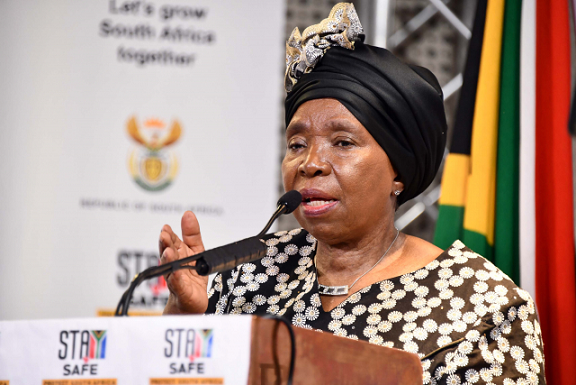
Cooperative Governance and Traditional Affairs (Cogta) minister Nkosazana Dlamini-Zuma has gazetted new regulations aimed at lifting South Africa’s national state of disaster, reports BusinessTech.
Dlamini-Zuma said in a media briefing on Tuesday evening (29 March) that these regulations will help inform the government’s decision on when and how to lift the state of disaster in the coming weeks. These regulations are currently open for public comment until 17:00 on Friday (1 April).
She added that the state of disaster cannot be lifted in a ‘reckless and abrupt manner’, and that some rules would likely remain in place for a further 30-day period once it is lifted.
Based on the comments received from the public, President Cyril Ramaphosa is expected to address the nation on lifting the state of the disaster, before the 15th of April.
Representations can be submitted online following the following link: https://forms.office.com/r/tMMP6WLEf2 or by email using the following address:
Mandatory protocols when in a public space according to the regulations gazetted:
- The wearing of a face mask is mandatory for every person when in an indoor public space, excluding a child under the age of six years.
- No person will be allowed to use, operate, or perform any service on any form of public transport without a mask.
- No person will be allowed to enter or be in a building, place or premises, including government buildings, places or premises, used by the public to obtain goods or services if he or she is not wearing a face mask.
- All persons in an open public space need not wear a face mask but must maintain a distance of at least one metre from another person.
- The school environment is excluded from the requirement of maintaining a distance of at least one metre from another person.
- An employer may not allow any employee to perform any duties or enter the employment premises if the employee is not wearing a face mask while performing his or her duties.
Regulations on Gatherings:
All gatherings are permitted at 50% of the venue capacity:
- Provided persons are fully vaccinated and in possession of a valid vaccination certificate; or
- Unvaccinated but in possession of a valid certificate of a negative Covid-19 test which was obtained not more than 72 hours before the date of the gathering.
Alternatively, according to the gazette, are gatherings permitted for unvaccinated people and those without tests but are limited to 1 000 persons or less for indoor venues and 2 000 persons or less for outdoor venues.
If the venue is too small to hold the prescribed number of persons observing a distance of at least one metre from each other, then not more than 50% of the capacity of the venue may be used.
Hotels, lodges, bed and breakfasts, timeshare facilities, resorts and guest houses are allowed full capacity of the available rooms for accommodation, with patrons wearing face masks and observing a distance of at least one metre from each other when in common spaces.
Regulations on the partial re-opening of borders:
The 21 land borders which are fully operational, will remain as such and the 32 land borders which were closed, will remain closed.
The Cabinet member responsible for Home Affairs may, from the date of commencement of this amendment to the Regulations, issue directions regarding the opening and closing of any further Ports of Entry.
Travelling to and from the Republic from neighbouring countries is allowed. Provided that travellers who are:
- Fully vaccinated must upon arrival at the land border produce a valid vaccination certificate; and
- Unvaccinated must upon arrival at the land border, provide a valid certificate of a negative COVID-19 test, recognised by the World Health Organisation, which was obtained not more than 72 hours before the date of travel.
International air travel is restricted to the following airports:
- OR Tambo International Airport;
- King Shaka International Airport;
- Cape Town International Airport;
- Lanseria International Airport; and
- Kruger Mpumalanga International Airport.
In the event of the traveller’s failure to submit a certificate as proof of a negative COVID-19 test, the traveller will be required to do an antigen test on arrival at his or her own cost and in the event of a traveller testing positive for COVID-19, he or she will be required to isolate him or herself at his or her own cost, for a period of 10 days.
Source: BusinessTech
Read the Gazette here.